
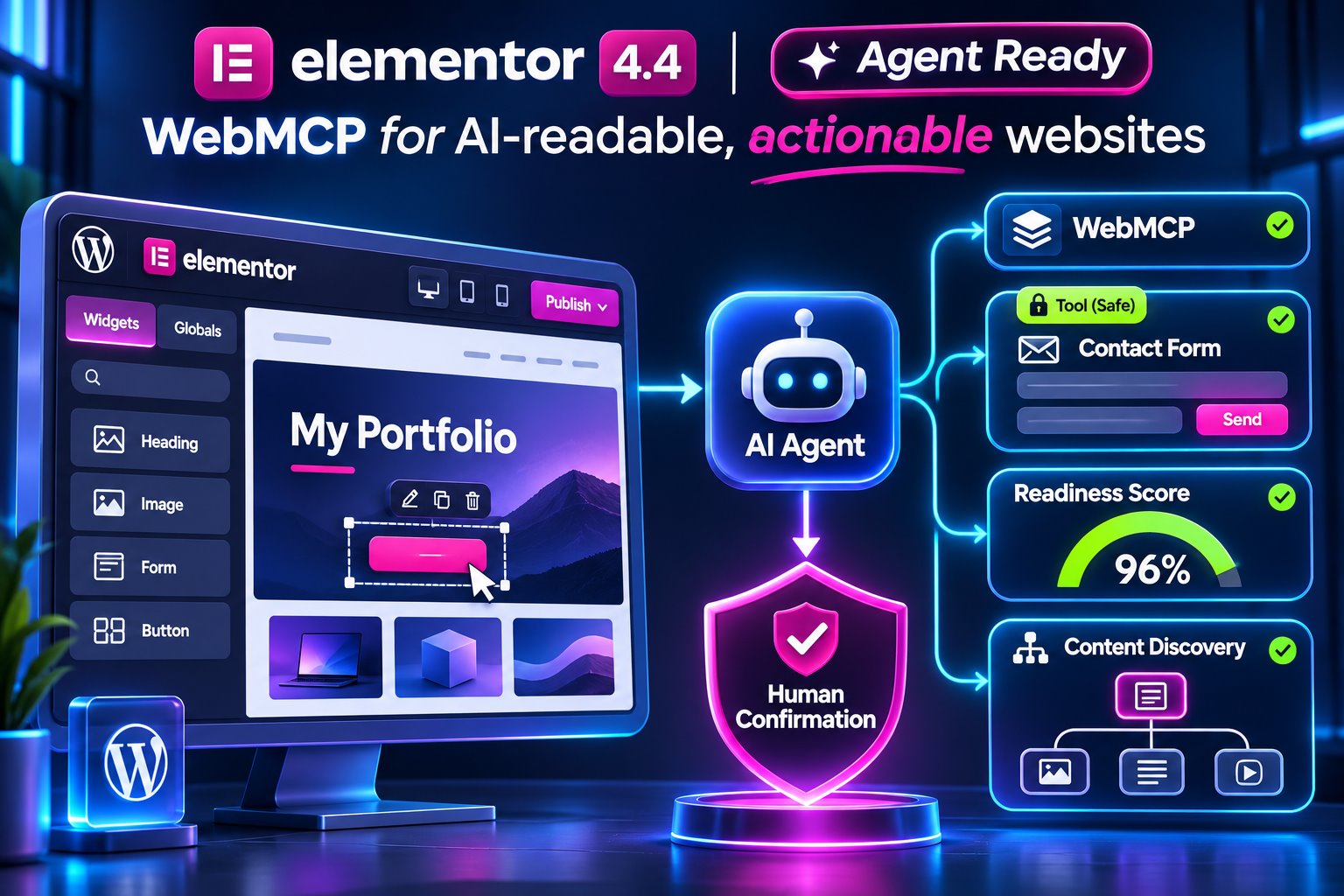
It is a set of features for making content easier for AI agents to discover and read, including readiness scoring, content-discovery controls and bot-access settings. It is different from Elementor MCP, which lets a connected AI tool edit the site.
Agent Ready is about visitors’ agents, not your editor
Elementor’s Agent Ready feature focuses on the public side of the website. Version 4.4 lists readiness scoring, content discovery and bot access controls. Elementor has also described markdown versions and an llms.txt option as part of its approach.
These additions can improve machine readability, but they do not replace semantic HTML, useful page copy, crawlable links or a sitemap. An “agent-ready score” is a diagnostic signal, not a Google ranking factor and not a promise that ChatGPT, Gemini or other systems will cite the page.
WebMCP lets a page expose structured actions
WebMCP is a draft browser API that allows a website to describe actions as tools. Instead of visually guessing where the contact fields are, a compatible browser agent could discover a structured “send inquiry” tool and its required inputs.
Elementor 4.4 adds WebMCP support to forms created through Elementor MCP. The practical opportunity is better form discovery. The practical risk is that actions run inside a visitor’s authenticated browser context. Start with read-only tools and keep consequential actions behind clear human confirmation.
Elementor MCP gained useful operational controls
Elementor’s changelog lists more supported legacy and Pro widgets, image upload, cache clearing, system information, experiment management and revision-based undo. Pro adds popup triggers, advanced rules, form submissions and more WooCommerce widget controls.
This makes AI-assisted maintenance more capable. It also increases the importance of least-privilege users, revocable Application Passwords, HTTPS and review before publication. The safest workflow still uses drafts and revisions.
Atomic Editor improvements are useful without AI
- Atomic List provides flexible markers and nested items.
- Atomic Carousel supports nested content, navigation and pagination styling.
- The SVG Icon Library adds Font Awesome 7 support.
- Atomic Forms gain redirect and popup actions after successful submission.
- Google Maps and additional Accordion controls expand common layout options.
Do not enable every experiment on a live site. Evaluate whether the feature reduces custom code, improves editing or replaces a heavier widget. Otherwise, novelty becomes technical debt.
Elementor 4.4 upgrade checklist
- Clone the site to staging and take a restorable backup.
- Update Elementor Core and Pro together.
- Regenerate CSS and data only if the upgrade process requires it.
- Check global classes, variables, templates, loops, popups and forms.
- Test desktop, tablet and mobile layouts plus keyboard focus.
- Verify performance before enabling Agent Ready or additional experiments.
- If MCP is connected, review its user, password and permission scope.
Frequently asked questions
Is WebMCP a finished web standard?
No. The November 2026 specification is a Community Group draft and explicitly is not a W3C Standard. Implement it as progressive enhancement.
Does Agent Ready guarantee AI traffic?
No. It can make content easier to discover or interpret, but citation and ranking decisions belong to external systems.
Is Elementor MCP the same as WebMCP?
No. Elementor MCP connects your chosen AI tool to the WordPress editor. WebMCP exposes page actions to compatible agents visiting through a browser.
Official sources
Elementor 4.4 is meaningful because it separates editing agents from visitor agents. Use both carefully: clean content for discovery, limited permissions for editing and human approval for actions.