
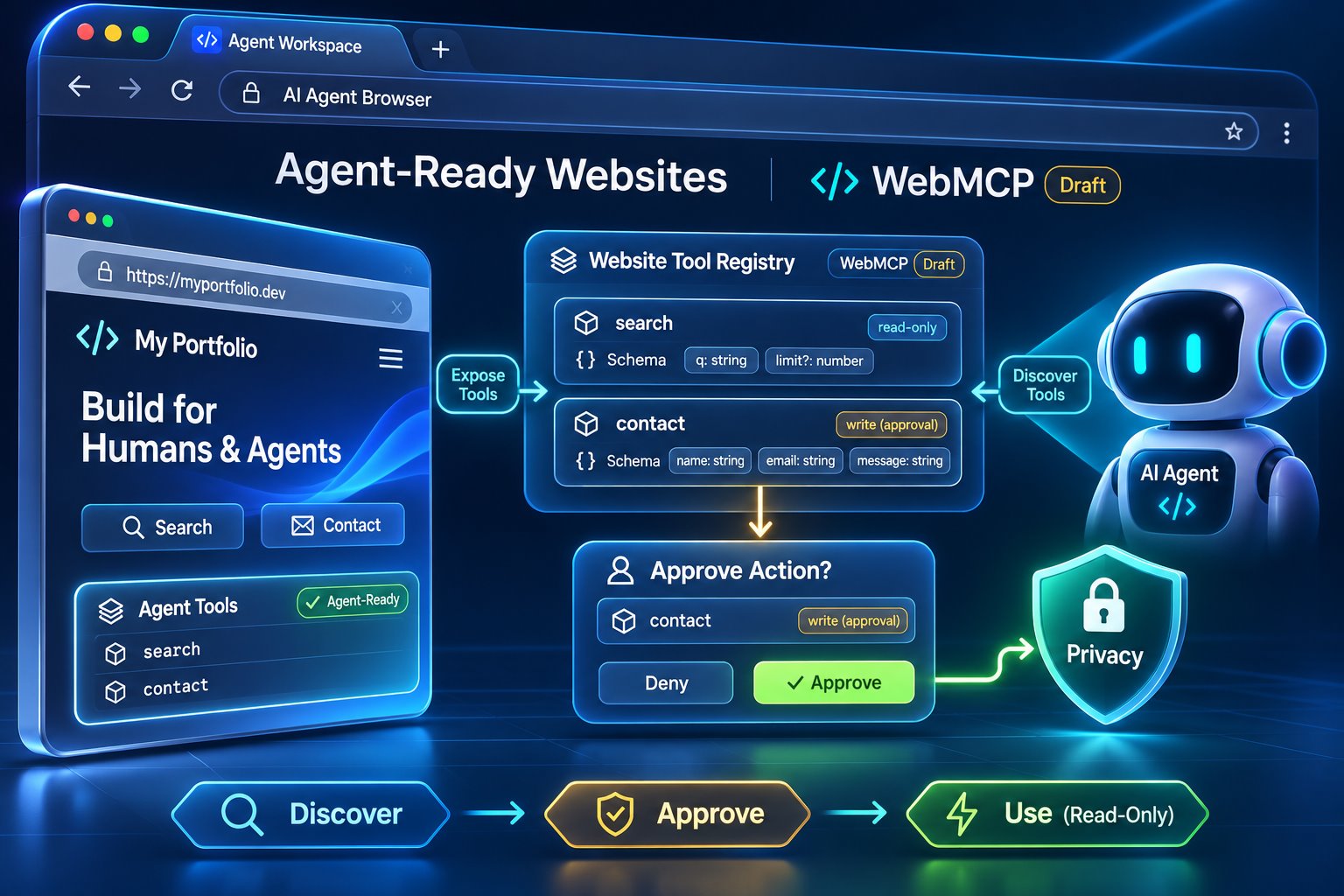
No. The specification published on 2 November 2026 is a Web Machine Learning Community Group draft and explicitly says it is not a W3C Standard or on the W3C Standards Track.
“Agent ready” has three practical meanings
An agent may need to read a page, retrieve a specific fact or perform an action. Those are different engineering problems. A website can be excellent for reading and still provide no safe way for an agent to submit a form or change an account.
Do not turn “agent ready” into another vague badge. Define the user goal, the data the agent needs and the consequence of each action.
The three layers of an agent-ready website
1. Readable content
Semantic HTML, descriptive headings, clear navigation, server-rendered text and meaningful alt text help people, search engines, assistive technology and agents.
2. Discoverable knowledge
Structured data, feeds, sitemaps, internal links and accurate entity information help systems find relationships. Files such as llms.txt or markdown representations may help some agents, but they are not universal ranking controls.
3. Structured actions
APIs, MCP servers and WebMCP tools can let an agent search, book, submit or update. This is the highest-risk layer because the agent may act with a logged-in user’s permissions.
What WebMCP changes
WebMCP lets client-side JavaScript register tools with names, descriptions and structured input schemas. A browser agent can discover those tools instead of guessing how to manipulate the visible interface.
A search tool might be read-only. A contact tool sends data. A checkout or account-deletion tool has greater consequences. The draft includes hints about tool behavior, but the browser and agent still need to enforce safe interaction.
Prompt injection and confused permissions remain real
A review, comment or product description could contain instructions designed to manipulate an agent. Authenticated browser context can also expose actions that a logged-out visitor cannot perform.
- Start with read-only, low-risk tools.
- Validate every input on the server even when the agent supplied it.
- Enforce authorization at execution time.
- Require explicit human approval for consequential actions.
- Log tool calls without collecting unnecessary sensitive data.
- Keep the normal accessible interface available as a fallback.
What this means for WordPress
WordPress already offers REST APIs, the Abilities API and an MCP Adapter ecosystem. Elementor 4.4 adds an Agent Ready area and WebMCP support for certain forms. That makes WordPress a useful testing ground, not proof that every plugin action is safe to expose.
Plugin authors should define narrow capabilities. Site owners should review the connected user, application passwords, bot controls and every public action.
A practical 2027 checklist
- Fix semantic HTML, keyboard access, labels and mobile usability.
- Keep essential content available in crawlable HTML.
- Use accurate Article, Person, Organization, Product or Service schema only where appropriate.
- Publish stable contact, policy and service information.
- Map proposed tools by risk: read, write, purchase, permission change or deletion.
- Add confirmation, authentication and server-side validation.
- Test with compatible agents, then test the human fallback.
Primary sources
Build a great website first. Then expose the smallest useful machine-readable surface, with stricter controls as actions become more consequential.